DPR Advanced Wastewater Treatment System
A five-stage multi-barrier treatment system designed to convert secondary municipal wastewater into EPA-compliant potable water at 40 MGD.
Institution: Florida International University
Course: Senior Design - Spring 2026
My role: Systems Analyst & Process Modeler
Team: 8 engineers
Overview
Water scarcity in the American Southwest and coastal Florida is driving demand for alternative supply strategies. Direct Potable Reuse (DPR) — converting treated wastewater directly into drinking water — is one of the most viable solutions. This project designed a complete treatment train from the ground up: selecting technologies, sizing every unit process, and verifying compliance with EPA MCLs and California Title 22 DPR standards.
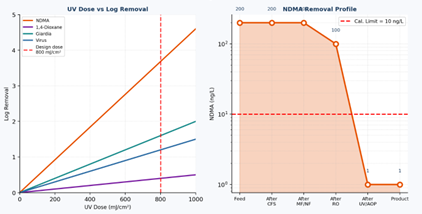
The final design achieves >99.98% TDS reduction, full pathogen log-removal credit, and destruction of trace organics including NDMA and 1,4-dioxane — all within a 34.2 MGD finished-water output at a modeled unit cost below $1.50/1,000 gallons.
Process Design

Results
Regulatory compliance achieved across all parameters
The complete treatment train was modeled end-to-end using a custom Excel process model. All parameters meet or exceed EPA drinking water standards and California DPR targets.
End-to-end system performance
Pathogen log removal credits - California 12/10/10 framework
Operational Considerations
I authored this section of the report, analyzing the four primary operational challenges and the strategies to manage them across the full treatment train.
Environmental Performance & Lifecycle
My contributions
Within an 8-person team, I owned the quantitative backbone of the project - translating the treatment train design into a fully dynamic Excel model and leading the technical sections that synthesize performance across all stages.
Methods & Tools
This project required both technical depth and systems-level thinking - from thermodynamic calculations to regulatory cross-referencing across EPA, California Title 22, and WHO frameworks.
Project Gallery